 blog
blog
Is FEC Consulting Worth the Investment?
Table of Contents
- What FEC Consulting Actually Covers
- Understanding Family Entertainment Center Feasibility Studies
- FEC Consulting Costs: What You'll Actually Pay
- Measuring ROI: Does FEC Consulting Pay for Itself?
- Step 1: Write down the decision the consulting is supposed to improve
- Step 2: Estimate the cost of getting the decision wrong
- Step 3: Set the baseline metrics before the engagement starts
- Step 4: Define what success looks like in numbers
- Step 5: Separate the consultant's impact from everything else
- A simple ROI calculation you can actually run
- When the ROI math says no
- Building Your Family Entertainment Center Business Plan
- FEC Consultant Selection Checklist: How to Choose the Right Firm
- When FEC Consulting Is Worth the Investment
- Alternatives to Hiring an FEC Consultant
- Frequently Asked Questions
Last Updated: October 5, 2026
What FEC Consulting Actually Covers
FEC consulting worth the investment depends on what a consultant actually does: feasibility assessments, operational audits, and staff training.
An FEC consultant brings expertise in market analysis, site selection, financial projections, and operational benchmarking. They test your concept against real-world data, flag obstacles before you invest capital, and build a roadmap to profitability.
At Turfway Entertainment, we work with startups launching a first location and established operators modernizing facilities, some need a full feasibility study before approaching lenders, others an operational health check on a struggling food and beverage program, or event sales and staff training.
Understanding Family Entertainment Center Feasibility Studies
A family entertainment center feasibility study analyzes whether your FEC concept can work in a specific market and location. It's the document lenders and investors want before committing capital.
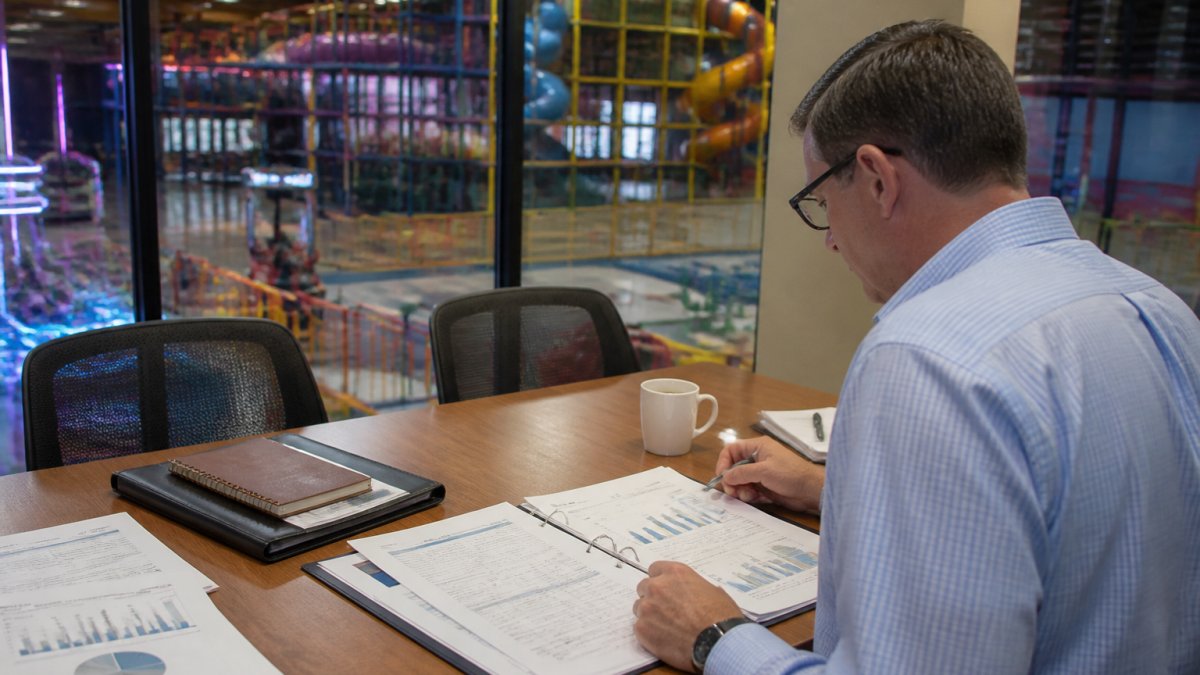
A solid study includes demographic analysis, competitive landscape assessment, financial projections based on comparable venues, and location-specific operational recommendations. It answers: Who will visit? How often?
The study should be grounded in data, not optimism.
FEC Consulting Costs: What You'll Actually Pay
Most FEC consulting pages dodge this question, but price is the first thing a buyer needs to judge whether the investment is worth it. Here's how consultants structure fees and how to compare proposals. Evaluating these costs requires a broader look at how a strategic planning investment aligns with long-term operational goals and overall facility performance.
The four engagement models you'll encounter
Fixed-fee project. A single price for a defined deliverable, feasibility study, business plan, or operational audit.
Hourly or daily rate. Common for advisory work and short engagements where scope is unclear. Ask for a not-to-exceed cap.
Retainer. A monthly fee for ongoing access, typically used by established operators who want a standing advisor on pricing, capital projects, or staffing.
What actually drives the price
- Scope and deliverable count. A single feasibility study is one deliverable; a launch package with feasibility, business plan, vendor selection, and staff training is four or five. Each adds cost.
- Primary vs. desk research. Published data and phone interviews cost less than site visits, customer surveys, and mystery shopping.
- Market complexity. Dense metro markets with many competitors require more analysis than a small market with two or three venues.
- Timeline. Rush engagements cost more, a three-week study instead of eight carries a premium.
Questions that expose a padded proposal
Ask every consultant these before comparing quotes:
- What is the exact list of deliverables, and in what format?
- How many hours of primary research and how many site visits are included?
- Who does the work, the person pitching me, or a junior analyst?
- What happens if scope changes mid-engagement? Is there a change-order process?
- What does post-delivery support look like, and is it included or billed separately?
A vague proposal is a placeholder. Push for specifics before you sign.
How to compare two proposals that don't look alike
Don't compare total price, compare price per deliverable. Divide the fee by concrete outputs (report, financial model, staffing plan, training sessions) and the "cheaper" proposal is usually more expensive per unit. Then ask which deliverables you actually need: if you have a solid business plan and only need a feasibility study for your lender, don't pay for a full launch package.
The cost you should actually be weighing
The consulting fee is not the real cost. The real cost is the fee plus the mistakes you'd have made without guidance, a lease signed on bad demographics, a buildout sized for wrong traffic assumptions, a food and beverage program that never hits margin. Those numbers dwarf any invoice. Ask each consultant to walk you through a past client where their recommendation changed the plan; that answer tells you what you're really buying.
Measuring ROI: Does FEC Consulting Pay for Itself?
Every consulting page says ROI is "measurable if you define success clearly", none show you how. Here's a framework to apply before you sign, so you can hold the consultant accountable to a number instead of a feeling.
Step 1: Write down the decision the consulting is supposed to improve
ROI only exists relative to a decision. Before you hire anyone, finish this sentence: "I am hiring a consultant because I need to decide whether to ______." Common answers:
- Sign a lease on a specific site
- Move forward with a buildout at a specific budget
- Refinance or restructure an underperforming venue
- Add or remove a revenue stream (food and beverage, laser tag, redemption, party packages)
If you can't name the decision, you're not ready to hire a consultant. You're ready to do more research.
Step 2: Estimate the cost of getting the decision wrong
This number makes ROI obvious. For a site decision, the cost of being wrong is the lease term plus buildout plus ramp-up losses, often the largest single number in a new venue's life. For an event sales overhaul, it's the revenue left on the table.
You don't need precision, an order of magnitude. If a wrong decision costs six or seven figures and the fee is a fraction of that, the ROI question is whether the consultant can reduce the probability of being wrong, not whether the fee is "worth it."
Step 3: Set the baseline metrics before the engagement starts
You cannot prove ROI without a before-and-after. Pull these before the consultant's first day:
- Revenue per visit
- Visit frequency per customer (or household)
- Event booking rate and average event value
- Food and beverage attachment rate and spend per guest
If you're pre-launch, your baseline is the assumptions in your current plan. Write them down, the consultant's job is to test them.
Step 4: Define what success looks like in numbers
Agree on this in writing. Targets that make ROI calculable:
- Feasibility study identifies a site with materially stronger demographics, or confirms the original site is sound
- Event sales program produces a measurable increase in booked events within two quarters
- Food and beverage attachment rate improves by a defined margin
- Labor cost as a percentage of revenue drops by a defined amount
- Buildout comes in at or under budget because the consultant caught scope problems early
If the consultant won't commit to measurable targets, treat the fee as a cost, not an investment, and price it accordingly.
Step 5: Separate the consultant's impact from everything else
You can rarely isolate a consultant's contribution perfectly, market conditions, seasonality, staffing, and your own execution all move the numbers. Two practical approaches:
Use a comparison group. With multiple locations, apply the recommendations at one and not the others, then compare. The cleanest test for a multi-unit operator.
Use a counterfactual. Ask what you would have done without the consultant. If the answer is "signed the lease anyway" or "kept the same event program," the delta between what happened and what would have happened is the ROI.
A simple ROI calculation you can actually run
ROI = (Value of improved decision + Value of avoided mistake + Value of operational gains) − Consulting fee, divided by the consulting fee.
For a startup, "avoided mistake" usually dominates; for an established venue, "operational gains" does. If you can't fill in any term with a defensible number, you don't have a business case, you have a hope.
When the ROI math says no
Sometimes it does. If your decision is small, reversible, and cheap to get wrong, the fee can't be justified, make the call yourself. If you have deep operating experience in your venue type and market, the marginal value of outside guidance shrinks. And if you won't act on the recommendations, ROI is zero no matter how good the report is.
Building Your Family Entertainment Center Business Plan
Your FEC business plan is the foundation for securing financing, hiring staff, marketing, and operations. A consultant helps you build one grounded in reality.
A strong plan includes market analysis, competitive positioning, realistic financial projections, operational workflows, and a clear path to profitability. It covers staffing, food and beverage strategy, event programming, customer acquisition costs, and retention, plus risks and mitigation.
Many entrepreneurs skip this step or plan in isolation.
FEC Consultant Selection Checklist: How to Choose the Right Firm
Selecting the right FEC consultant matters as much as deciding to hire one.
Look for direct experience launching or operating family entertainment centers, generic business consultants who dabble in entertainment lack the specific knowledge.
Evaluate their approach: feasibility and planning only, or implementation too? Can they help with staff training, event sales strategy, or food and beverage optimization?
Key evaluation criteria:
- Direct experience with FEC launches or operations
- Specific expertise in your venue type (arcade-focused, activity-based, hybrid model)
- Clear scope of work and deliverables
- References from recent clients
- Willingness to help with implementation, not just planning
When FEC Consulting Is Worth the Investment
FEC consulting is worth the investment when you face a significant decision or operational challenge that could impact profitability.
It's less valuable if you have deep industry experience and clear market understanding, if the decision is small and low-risk, or if you won't act on the recommendations.
The real question isn't whether consulting is expensive, it's whether the cost of a bad decision is higher than the cost of expert guidance.
Alternatives to Hiring an FEC Consultant
Not every FEC owner needs a consultant. Understanding the alternatives helps you decide.
Industry associations and peer networks. Family entertainment organizations offer resources, benchmarking data, and networking (Family Entertainment Centers | Constituencies).
Lender-required feasibility studies. Some lenders accept a study from a qualified third party, cheaper than a full consulting engagement, addressing financing without broader operational consulting.
DIY research and planning. You can research your market, analyze competitors, and build projections yourself.
The trade-off is cost versus risk.
The decision to invest in FEC consulting ultimately depends on the stakes of your situation.
Frequently Asked Questions
Is FEC consulting worth the investment for a startup with limited capital?
For startups, FEC consulting typically delivers value by preventing costly mistakes in design, layout, and operational setup that could drain your budget later. A feasibility study helps you secure financing by proving viability to lenders, which can unlock capital you wouldn't otherwise access. The upfront consulting cost is often recovered through better site selection, vendor negotiation, and avoided redesigns. However, if your capital is extremely constrained, you might start with targeted consulting on your weakest area, feasibility or F&B operations, rather than a full engagement.
How can I measure the ROI of an FEC consultant?
Track metrics before and after consulting engagement: operational labor costs, food and beverage margins, capacity utilization rates, customer retention, and revenue per square foot. Compare your actual performance against the consultant's projections. For new builds, measure whether you opened on time and on budget, and whether your first-year revenue met or exceeded the feasibility study forecast. For existing centers, look for improvements in staff productivity, reduced waste, or increased event bookings. The strongest ROI signal is whether lenders approved your financing based on the consultant's study.
What makes FEC consulting different from running a center on your own experience?
Experience in one venue doesn't always transfer to different market conditions, venue sizes, or demographic profiles. FEC consultants bring data from dozens of centers across different regions, which reveals patterns individual operators miss. They bring specialized expertise in areas like family entertainment center feasibility studies, food and beverage optimization, and workforce development that take years to develop alone. Consultants also provide third-party credibility when you need financing approval or investor confidence, lenders trust independent analysis more than internal projections.
Can FEC consulting help an existing center that's underperforming?
Yes. A consultant can conduct an operational health check to identify why your center isn't meeting targets. Common issues include poor F&B execution, underutilized event space, inefficient staffing, or outdated pricing strategy. Consultants can recommend specific changes, like restructuring your food and beverage program, launching targeted event sales, or retraining your team, that often improve profitability within 90 days. The key is choosing a consultant who has successfully improved existing centers, not just launched new ones, and asking for evidence of outcomes from similar turnaround situations.