 how-to
Managing Entertainment Center Staff Effectively
Table of Contents
- Define Clear Roles and Responsibilities
- Hire and Select Qualified Staff for Your Entertainment Venue
- Family Entertainment Center Employee Training Programs
- Entertainment Center Employee Onboarding Checklist
- Entertainment Center Staff Scheduling and Shift Management
- Reducing Staff Turnover in Family Entertainment Centers
- Measure Performance and Provide Ongoing Feedback
- Frequently Asked Questions
Last Updated: October 9, 2026
Define Clear Roles and Responsibilities
Managing entertainment center staff starts with clarity: every team member needs to know exactly what they're responsible for and what success looks like.
Document each position: core duties for game attendants, food service staff, event coordinators, and management. Be specific, not "customer service" but greeting guests, answering game-rule questions, handling complaints, restocking prizes.
Create a responsibility matrix. Map out who owns which decisions:
- Game floor operations: Who adjusts machines? Who handles technical issues?
- Food service: Who takes orders? Who handles refunds? Who cleans stations?
- Events: Who books parties? Who sets up rooms? Who manages the timeline?
- Safety: Who checks equipment daily? Who reports hazards?
Post these documents where staff can access them, review them during onboarding, and update them when operations change. This eliminates confusion and cuts the time managers spend answering "Is this my job?"
Hire and Select Qualified Staff for Your Entertainment Venue
The quality of your team depends on hiring the right people from the start. Entertainment venues need staff who can handle fast-paced environments, interact positively with families, and stay calm under pressure.
Define what you're looking for before posting the job. Do you need arcade-machine troubleshooters, or can you train that? Do you need speed for a high-volume venue, or personality for a smaller one?
Look for these qualities when interviewing:
- Customer interaction skills: Can they handle frustrated guests? Do they smile naturally?
- Reliability: Do they show up on time? Do their references confirm this?
- Problem-solving: When something breaks or a guest complains, can they think through solutions?
- Teamwork: Do they describe past jobs as "I did X" or "we did X"?
- Energy level: Can they maintain enthusiasm through a busy shift?
Ask behavioral questions: instead of "Are you a team player?" ask "Tell me about a time your team had a conflict. What did you do?"
Run background checks for positions involving cash or child safety. Check references thoroughly, a quick call to a previous manager takes five minutes and prevents hiring problems later.
Family Entertainment Center Employee Training Programs
Training is where new hires become effective. Without structure, you get inconsistent service, safety gaps, and frustrated staff.
Build a training program that covers these core areas:
- Safety protocols: Emergency procedures, equipment operation, hazard identification
- Guest service standards: How to greet guests, handle complaints, upsell experiences
- Game and equipment knowledge: How machines work, common issues, troubleshooting basics
- Food service: If applicable, proper handling, hygiene, order accuracy
- Point-of-sale systems: How to ring up sales, process refunds, handle disputes
- Conflict de-escalation: How to calm upset guests without escalating situations
Pair new staff with experienced team members. Shadowing beats lectures: trainees work alongside someone skilled, then gradually take the lead while observed. It takes longer upfront but prevents costly mistakes.
Create a checklist for trainers. What specific tasks must a new hire demonstrate before they work unsupervised? For game floor staff, maybe it's: operate three types of machines, handle a guest complaint, reset a jammed ticket dispenser. For food service: take an order accurately, process a refund, clean a station to standard.
Test knowledge before people work independently, a safety quiz or a difficult-guest role-play confirms readiness, protects your venue, and builds confidence.
Entertainment Center Employee Onboarding Checklist
Onboarding sets the tone for retention and performance. A structured first week makes people feel welcomed and prepared, not thrown into chaos.
Use this onboarding checklist for all new hires:
- Provide employee handbook and have them sign acknowledgment
- Tour the entire facility: game areas, food service, restrooms, emergency exits, break room
- Explain safety procedures and point out emergency equipment
- Introduce them to their direct supervisor and key team members
- Complete paperwork: tax forms, direct deposit, emergency contact
- Explain compensation, break policies, and time-off procedures
- Assign locker or storage space
- Set up system access: POS register, time clock, communication channels
- Conduct first-day training on your specific venue's layout and procedures
- Assign a mentor or experienced buddy for the first week
- Schedule daily check-ins during the first two weeks
- Conduct a one-week review: ask what's confusing, what's going well
- Set expectations for the first 30 days: what they should master, when they work independently
Make the first day low-pressure: have them shadow, ask questions, and meet people. Don't throw them on the busiest shift.
Check in frequently during weeks one and two. A quick "How's it going? Any questions?" prevents small confusion from becoming big problems, and supported new hires are far more likely to stay.
Entertainment Center Staff Scheduling and Shift Management
Poor scheduling creates understaffing, overtime, and burnout.
Build your schedule around demand patterns by zone, not just by day. Track the busiest hours for the arcade floor, redemption counter, food service line, party rooms, and ride operators.
Use a zone-and-role staffing matrix to assign coverage. For each shift, map who owns which zone and which role:
- Floor and attractions: Game attendants who roam the arcade floor, reset machines, assist guests, and monitor ride or attraction queues.
- Guest service and redemption: Staff at the prize counter and front desk who handle redemptions, complaints, and lost-and-found.
- Food service: Counter and kitchen staff who take orders, prepare food, and keep stations clean.
- Maintenance and safety: A designated staff member who checks equipment, clears hazards, and handles minor repairs.
- Party and event support: Hosts who set up rooms, run timelines, and coordinate with food service and floor staff.
Cross-train so each zone has at least two people who can cover it, if only one person knows the party-room timeline, a single callout cancels a booking.
Align coverage to actual guest flow, not tradition. Compare point-of-sale attendance data to labor hours, overstaffing slow weekday mornings and understaffing Saturday afternoons is common.
Consider these factors when building schedules:
- Venue demand by zone: When does each area need the most hands?
- Staff availability: Who can work mornings, evenings, weekends?
- Skill mix: Do you need experienced staff on busy shifts to handle problems and de-escalate conflicts?
- Cross-training: Can multiple people cover each role, or does one person create a bottleneck?
- Labor costs: Can you afford full coverage at peak times, or do you need to stagger starts and ends?
- Staff preferences: Can you honor requests without creating gaps?
Post schedules at least two weeks ahead. Predictable schedules make people more reliable and less likely to leave; last-minute changes drive turnover.
Use a shift-management tool or spreadsheet to track coverage: can you see at a glance if Saturday night is understaffed, or who covers a sick callout?
Manage shift swaps formally: confirm both people are qualified for the other's role, approve it, and keep a swap log so you can see who actually worked which zone.
Review your schedule against outcomes. If a zone consistently runs short, the schedule is wrong; if labor cost creeps up while satisfaction drops, you may be overstaffing the wrong zones. Scheduling is a feedback loop, not a one-time task.
Reducing Staff Turnover in Family Entertainment Centers
High turnover is expensive, you lose training investment, experience, and consistency. Reducing it means keeping good people.
People leave entertainment venue jobs over low pay, unpredictable schedules, feeling undervalued, and lack of growth (Report: HR Pros Rank Top Reasons for Turnover). You can't fix everything, but you can address several.
Offer competitive wages, predictable schedules, public recognition, and small advancement opportunities, shift lead, trainer, event coordinator. People stay when they see a future, not just a job.
Ask people why they're leaving. Exit interviews reveal patterns. If three people in a row say they couldn't get consistent hours, that's a scheduling problem you can fix.
Build team culture. Team lunches, milestone celebrations, and genuine recognition matter, when staff feel part of something rather than just filling shifts, they stick around.
Create a clear growth path: associate to lead to supervisor. People who see themselves advancing in a year or two are far more likely to stay than those who see a dead end.
Measure Performance and Provide Ongoing Feedback
You can't improve what you don't measure.
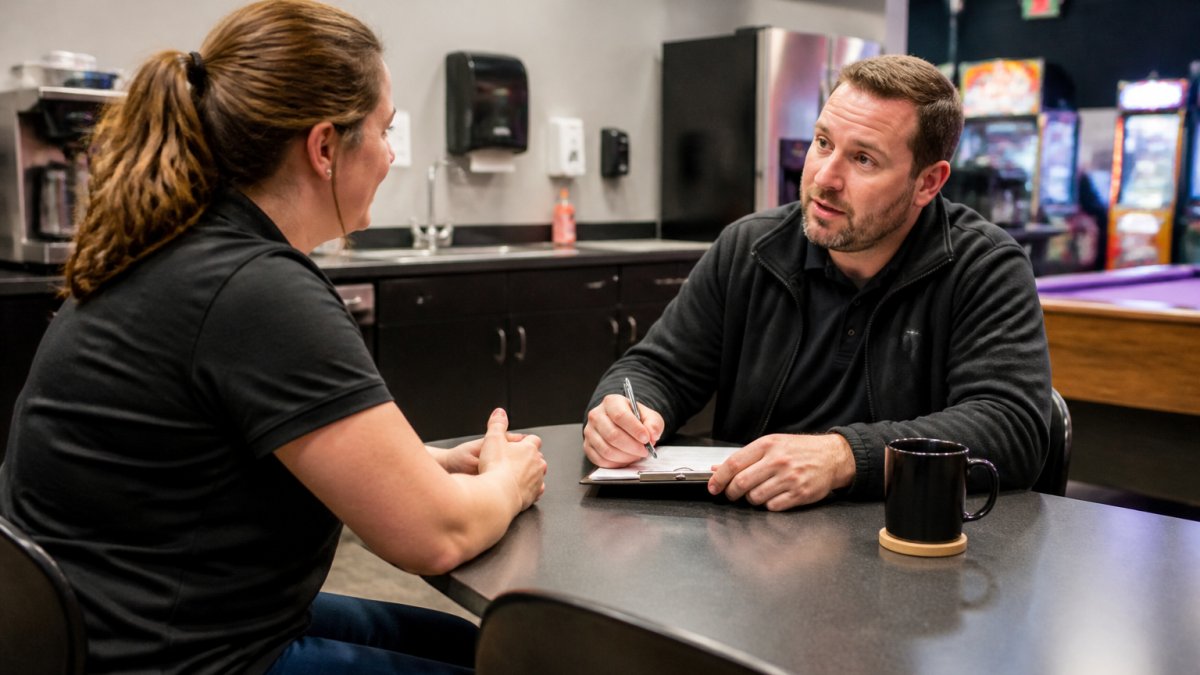
Identify the metrics that matter for each role:
- Game floor staff: Guest satisfaction, incident reports, machine uptime, customer complaints
- Food service: Order accuracy, speed, food safety compliance, customer feedback
- Event coordinators: Event bookings, customer satisfaction scores, on-time setup and breakdown
- All staff: Attendance, punctuality, safety incidents
Track these monthly and look for trends, not one-off events.
Add a few venue-level KPIs that connect staffing to the business:
- Labor cost as a share of revenue: Compare total labor hours to revenue by week. If the ratio climbs while guest satisfaction holds steady, you may be overstaffed in slow zones. If it drops while complaints rise, you may be understaffed at peak.
- Schedule coverage: The percentage of shifts filled without last-minute changes. Low coverage usually signals scheduling or cross-training gaps.
- Training completion: The percentage of staff signed off on each zone. Track this by zone, not just by person, so you can see where coverage is thin.
- Turnover rate: Track voluntary and involuntary separations monthly. A spike in voluntary turnover often follows a scheduling or recognition problem.
- Incident rate: Safety and guest-complaint incidents per 1,000 guests. Use it to spot zones that need more staffing or retraining.
Interpret these together.
Provide feedback regularly, not just at annual reviews. Monthly 15-minute one-on-ones covering what's going well and what needs improvement beat vague praise.
Give feedback that's actionable. Don't say "You need better customer service." Say "I noticed you didn't greet three guests who came to the counter yesterday.
Recognize good performance publicly. When someone handles a difficult situation well, mention it at a team meeting. When someone's attendance is perfect for a month, acknowledge it.
Address problems quickly. If someone's performance drops, talk to them immediately. Maybe they're struggling with something fixable. Maybe they need different training. Maybe the role isn't right.
For persistent issues, use a simple improvement process: verbal coaching, a written summary with specific expectations and a review date, then a follow-up meeting.
Frequently Asked Questions
How do you effectively manage staff in an entertainment center?
Start by defining clear roles and responsibilities so every team member understands their job. Hire people with the right attitude and skills for guest-facing roles. Invest in comprehensive onboarding and training, then use scheduled check-ins and performance feedback to keep staff engaged. Set measurable KPIs for service quality and operational efficiency, and address attendance or performance issues promptly. Regular pre-shift briefings and team communication keep everyone aligned on daily priorities and guest satisfaction goals.
What should an entertainment center employee onboarding checklist include?
A solid onboarding checklist covers venue tour and safety procedures, role-specific job duties, POS system and equipment training, guest service standards, emergency protocols, and your venue culture and values. Include hands-on shadowing with experienced staff, a written copy of their job description and responsibilities, and a clear schedule for their first two weeks. Assign a mentor or buddy, set a formal review date (typically 30 days), and confirm they understand workplace policies, break procedures, and how to report incidents or concerns.
How can managers reduce staff turnover in family entertainment centers?
Retention starts with hiring the right people and setting them up for success through strong onboarding and training. Pay competitively for your market, offer schedule flexibility when possible, and create a positive workplace culture where staff feel valued. Recognize good performance publicly, provide growth opportunities (like shift lead or trainer roles), and address problems early through one-on-one feedback rather than letting frustration build. Regular team communication, mental health support, and a clear path for advancement all signal that you invest in your people, which significantly reduces turnover.
How often should entertainment center staff receive feedback?
New hires should receive formal feedback at 30 days, 60 days, and 90 days during their probation period. After that, conduct quarterly or semi-annual performance reviews. However, ongoing informal feedback is just as important, brief daily or weekly check-ins during shifts help staff correct small issues before they become problems. Recognition for good work should happen immediately and publicly. If performance or attendance concerns arise, address them within days, not weeks, so the issue is fresh and correctable.