 ultimate-guide
Steps to Open a Family Entertainment Center in 2026
Table of Contents
- Market Feasibility and Demographic Analysis
- FEC Site Selection Criteria for 2026
- Cost to Open a Family Entertainment Center
- FEC Startup Budget Contingency Planning
- Family Entertainment Center Business Plan Template
- Attraction Mix, Facility Design, and Staff Training
- Post-Launch Sustainability and Digital Transformation
- Conclusion
- Frequently Asked Questions
Last Updated: September 20, 2026
Market Feasibility and Demographic Analysis
Opening a family entertainment center starts with proving the market can support it. A family entertainment center (FEC) is a commercial venue that combines multiple attractions, such as arcade games, soft play structures, and trampoline parks, under one roof and one admission model. This guide from Turfway Entertainment walks through the steps to open a family entertainment center in 2026, from feasibility study to grand opening.
Evaluating Local Demand and Competition
Demand analysis answers one question: how many paying visitors can this trade area realistically deliver? A common approach is to define a primary trade area, usually a 20-to-30-minute drive time, then layer in demographic analysis: population counts, household income, the number of families with children under 12, and school enrollment trends.
FEC Site Selection Criteria for 2026
Site selection determines your ceiling before you ever open the doors. The right building has the right size, the right visibility, and the right lease terms.
Rank candidates against these criteria:
- Visibility and access: strong road frontage, easy turns, and clear signage sightlines
- Parking ratio: roughly one space per 200 to 250 square feet of gross building area
- Ceiling height: clear heights that accommodate soft play structures and trampoline courts
- Co-tenancy: retailers that draw the same families you want
- Utilities and floor load: power capacity and slab strength for heavy attractions
Lease Negotiation and Zoning Requirements
Before signing anything, confirm zoning allows assembly and amusement use. Many otherwise perfect retail spaces sit in zones that prohibit arcades or require a conditional use permit, and that process can add months.
Cost to Open a Family Entertainment Center
The cost to open a family entertainment center varies widely with size, market, and attraction mix, so treat any single figure with suspicion. What matters is understanding the categories of spend and controlling the two that scale fastest: buildout and attractions.
Capital Expenditure Breakdown
Your capital expenditure plan should itemize every major category before you solicit bids:
- Real estate: deposits, rent during buildout, and leasehold improvements
- Attractions: soft play structures, trampoline courts, arcade games, and redemption counters
- Infrastructure: electrical upgrades, HVAC, flooring, and restrooms
- Technology: point of sale system, party booking software, and Wi-Fi
- Pre-opening: permits, business license, staff training, and marketing
FEC Startup Budget Contingency Planning
FEC startup budget contingency planning is the discipline of reserving capital for the costs you did not forecast. Change orders, permitting delays, and equipment lead times are normal, not exceptions. The gap in most guides is that they tell you to hold a contingency but never explain how to size it, when to release it, or what to do when the risk is not financial at all.
| Risk Category | Typical Trigger | Contingency Response |
|---|---|---|
| Construction overrun | Change orders, code upgrades | Hold 10-15% of hard costs |
| Permitting delay | Zoning review, inspections | Fund 2-3 months of carrying costs |
| Equipment slip | Manufacturer lead times | Order attractions first |
| Ramp-up shortfall | Slower early traffic | Reserve 3-6 months operating cash |
| Insurance or liability event | Claim, inspection finding | Carry adequate coverage and a reserve |
How to Size and Release the Contingency
A contingency is not a slush fund. Give it a release rule before you spend a dollar of it. A common pattern is to release contingency only against a documented change order or a written schedule impact, and to require the operator's sign-off above a set threshold. Without a rule, the contingency gets absorbed into upgrades during buildout, and the first permitting delay stalls the opening.
Beyond Money: Operational and Crisis Contingency
A financial contingency does not protect you from an equipment failure on a busy Saturday, a liability claim, or an emergency that requires evacuation. Build a written plan for each:
- Equipment failure: keep spare parts for your highest-traffic attractions, maintain a service contact list, and train staff on which attractions to close and how to redirect guests
- Liability claims: document every incident, preserve video, and notify your carrier promptly; your training records are your first line of defense
- Emergency protocols: post evacuation routes, run drills, and assign a floor lead who owns the response until help arrives
Family Entertainment Center Business Plan Template
A family entertainment center business plan template should follow the structure lenders expect, because financing usually depends on it. What actually gets a loan committee to say yes is a plan that answers their risk questions before they ask them.
- Executive summary (1-2 pages): concept, location, capital request, and the single reason your venue wins in this trade area
- Market feasibility (5-8 pages): trade area, demographic analysis, competitor pricing, and a defensible capture rate
- Attraction mix and facility design (3-5 pages): what you are building, why that mix, and floor plans with occupancy limits
- Operational plan (3-5 pages): staffing model, hours, workflows, and maintenance schedule
- Marketing strategy (2-3 pages): pre-opening, grand opening, and the retention program that follows
- Financial projections (5-10 pages): revenue streams, operating costs, seasonality, and debt service
- Risk and contingency (2-3 pages): the risks you have identified and how you will absorb them
Financial Projections and Lender Requirements
Lenders want conservative, defensible numbers. Break revenue into streams: admissions, arcade games, birthday party packages, food and beverage, and event hosting. Show operating costs line by line, including payroll, utilities, insurance, and maintenance.
- Three years of monthly projections, not annual totals, so they can see the ramp-up curve
- A debt service coverage ratio that holds in the slowest month, not just the average
- Owner equity contribution, typically a meaningful share of total project cost, with the rest financed
- Personal financial statements and resumes for every principal, because lenders are underwriting the operator as much as the concept
- A signed lease or letter of intent, since real estate is the largest fixed cost
The Second-Year Slump and Why Lenders Ask About It
Most business plan templates stop at opening day. Lenders who have financed entertainment venues know the pattern: strong first-year traffic driven by novelty, then a decline in year two as the local market has already visited once. Address it directly in the plan.
Attraction Mix, Facility Design, and Staff Training
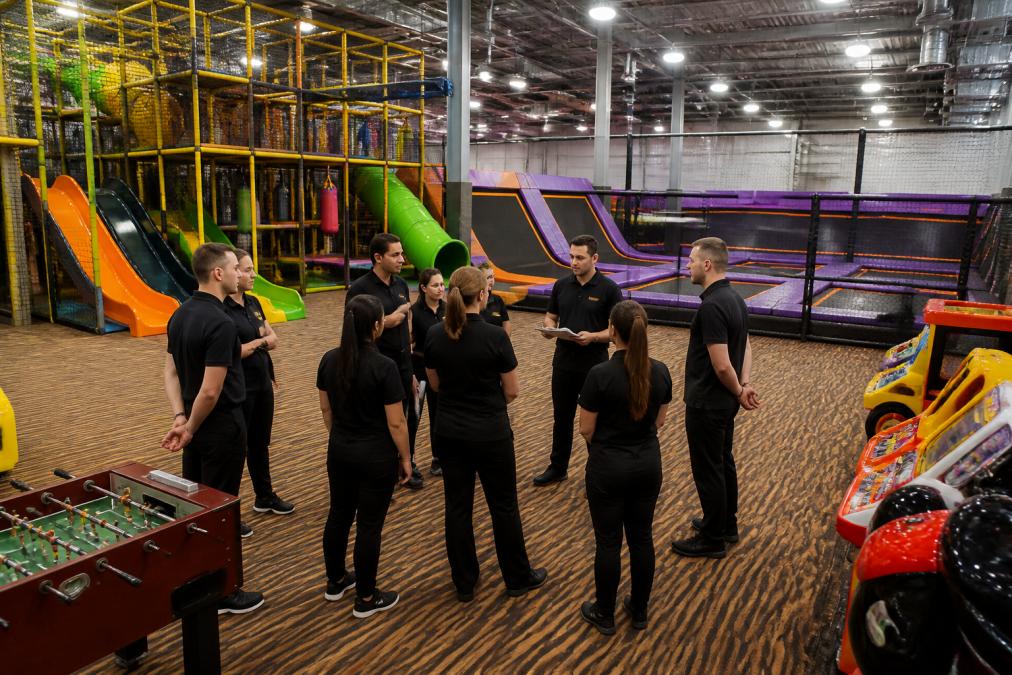
The attraction mix is where concept becomes experience. A balanced FEC pairs high-energy draws with lower-cost, higher-margin options.
Post-Launch Sustainability and Digital Transformation
The opening month is not the finish line. Post-launch sustainability comes from customer retention, and retention comes from repeat visits, memberships, and event hosting.
Conclusion
The venues that succeed are the ones that treat feasibility, financing, and operations as one connected system rather than separate projects. That is exactly where Turfway Entertainment helps, from concept development and feasibility studies to operational health checks and staff training, with specialized programs for FEC launches, food and beverage, and event sales. Our focus is minimizing risk so your decisions are made correctly the first time.
Frequently Asked Questions
Are family fun centers profitable in 2026?
Profitability depends on location, attraction mix, and operational efficiency. Centers with diversified revenue streams like birthday party packages, event hosting, and food and beverage service typically see stronger returns. A detailed market feasibility study and realistic financial projections are critical before investing. Many operators achieve positive cash flow within 18 to 24 months, but results vary based on local competition and demographic analysis.
What are the primary regulatory requirements for opening an FEC?
You will need a business license, occupancy permits, and safety compliance certifications for attractions like trampoline parks and soft play structures. Liability insurance is mandatory, and specific attractions may require additional inspections. Check local zoning laws and building codes early in your planning process. A family entertainment center business plan template should include a compliance checklist to avoid delays during construction and opening.
How do I secure financing for a new entertainment venue?
Lenders typically require a comprehensive business plan with market feasibility data, demographic analysis, and detailed financial projections. A realistic cost to open a family entertainment center estimate strengthens your application. Include contingency planning for construction overruns and initial operational costs. Many lenders also want to see industry experience or a consulting partner. Requesting a consultation with an FEC consultant can help you prepare lender-ready documentation.
What is considered a modern family entertainment center?
A modern FEC combines multiple attractions such as arcade games, soft play structures, trampoline parks, and event hosting spaces under one roof. Digital integration beyond point of sale systems, like online booking and loyalty programs, is increasingly expected. Sustainability features and flexible event spaces also define newer facilities. The attraction mix should align with local demographic analysis and niche market demand to maximize ROI.
How much does it cost to open a family entertainment center?
Costs vary widely based on size, location, and attraction selection. Major expenses include real estate lease or purchase, facility design and construction, equipment like arcade games and soft play structures, and initial operational costs. A detailed capital expenditure breakdown and startup budget contingency planning are essential. Pricing for consulting services depends on project scope, so request a consultation for a tailored estimate.
What are the most popular business ideas for family entertainment in 2026?
Popular concepts include trampoline parks, soft play structures for younger children, arcade games with digital integration, and event hosting for birthday party packages. Multi-attraction FECs that combine several revenue streams tend to perform best. Niche market concepts like STEM-focused play centers or eco-friendly operations are also gaining traction. Market feasibility and demographic analysis should guide your final attraction selection.